How SAINT Compares to Other Depression Treatment Options
If your depression has already survived a medication or two, the question isn't 'what treatments exist?' It's 'which one is most likely to get me all the way better, and how long will it take?'
Last updated September 9, 2026.
Want to know if SAINT® is right for you?
Tell us about your treatment history and symptoms. A consultation is an evaluation, not a commitment — and it starts with your story.
The two numbers worth caring about
If you've been living with depression for a while, you've probably heard about more than one way to treat it. Medication, obviously. Maybe a therapist mentioned TMS. Maybe you've read about ketamine or esketamine clinics. Maybe someone in your family had ECT decades ago and you've wondered whether it still exists.
Each of these is a real treatment with real evidence behind it. But they are not interchangeable, and the differences matter most for one group of people: those whose depression has already survived a medication or two. If that's you, the question isn't "what treatments exist?" It's "which one is most likely to get me all the way better, and how long will it take?"
This article puts the main options side by side so you can see how they compare on the two numbers that matter most:
Not "improvement," not "response." Remission means your symptoms drop to the point where you no longer meet criteria for depression. It's the difference between feeling somewhat better and feeling like yourself again.
How long, on average, it takes to get there. This matters more than people think. Every week spent depressed is a week of lost work, strained relationships, and eroded hope, and every failed treatment makes the next one harder to believe in.
Side-by-side comparison chart
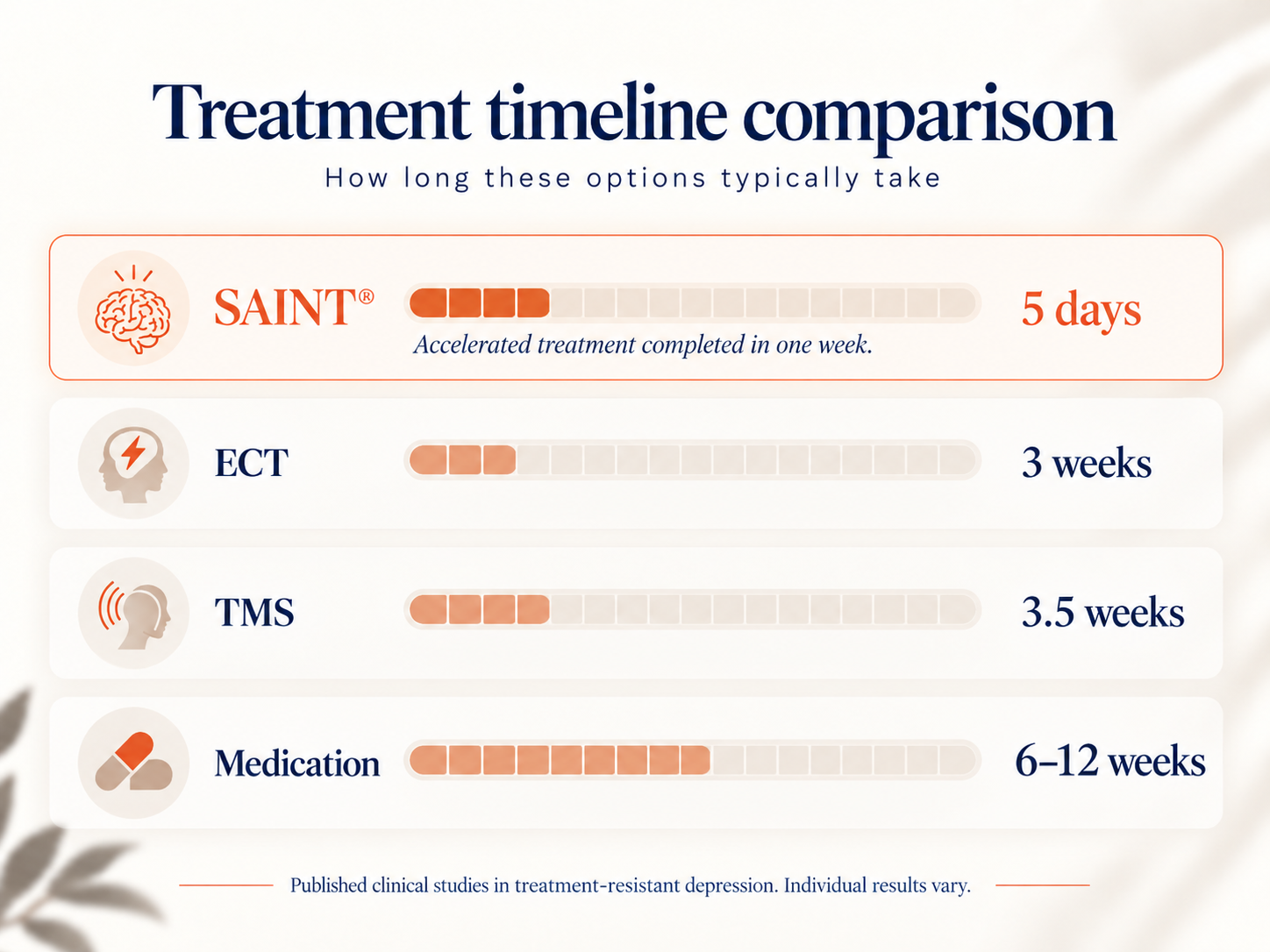
Here's how the major options stack up, drawing on published studies in treatment-resistant depression and related patient populations.
What each option actually involves
Medication. Antidepressants are the first line for good reason: they're accessible, inexpensive, and work for many people. But for someone who has already failed one or two, the odds of the next one producing remission drop sharply. The roughly 14 percent remission figure reflects that reality. Medications also take six to twelve weeks to show their full effect, and each one carries its own side-effect burden: dry mouth, headaches, digestive problems, sleep disruption, emotional blunting.
Esketamine. A nasal spray derived from ketamine, administered in a clinic under supervision. It can work quickly for some people, but the effect often fades and requires ongoing maintenance dosing, sometimes indefinitely. The remission figures are modest, and the long average time to sustained remission reflects the fact that many patients need months of repeated sessions. It also involves dissociation during treatment and a monitoring period afterward.
Standard TMS. Transcranial magnetic stimulation uses magnetic pulses to stimulate the mood-regulating region of the brain. It's noninvasive and well tolerated, with no anesthesia and no systemic medication. The limitation is the schedule: one session a day, five days a week, for six to nine weeks, which adds up to 30 to 36 clinic visits. And the target is located using external measurements of the head, not an image of your actual brain. Remission rates are meaningfully better than medication but still leave most patients short of full recovery.
ECT. Electroconvulsive therapy remains one of the most effective treatments in psychiatry, with remission rates around 48 percent in hard-to-treat populations. But it requires general anesthesia, typically involves two to three sessions a week for several weeks, and carries a known risk of memory problems. For many people it's a treatment of last resort, and the stigma keeps others from considering it at all.
SAINT. Stanford Accelerated Intelligent Neuromodulation Therapy is an FDA-cleared accelerated form of TMS, developed at Stanford's Brain Stimulation Lab. It's indicated for adults with major depressive disorder who haven't gotten adequate relief from antidepressants in their current episode. In published clinical trials, 79 percent of participants reached remission, with an average time to remission of 2.6 days.
Curious whether you'd qualify?
If you've tried medication and you're still not yourself, you may be a candidate for SAINT®. Our team will give you a straight answer.
Why SAINT's numbers look so different
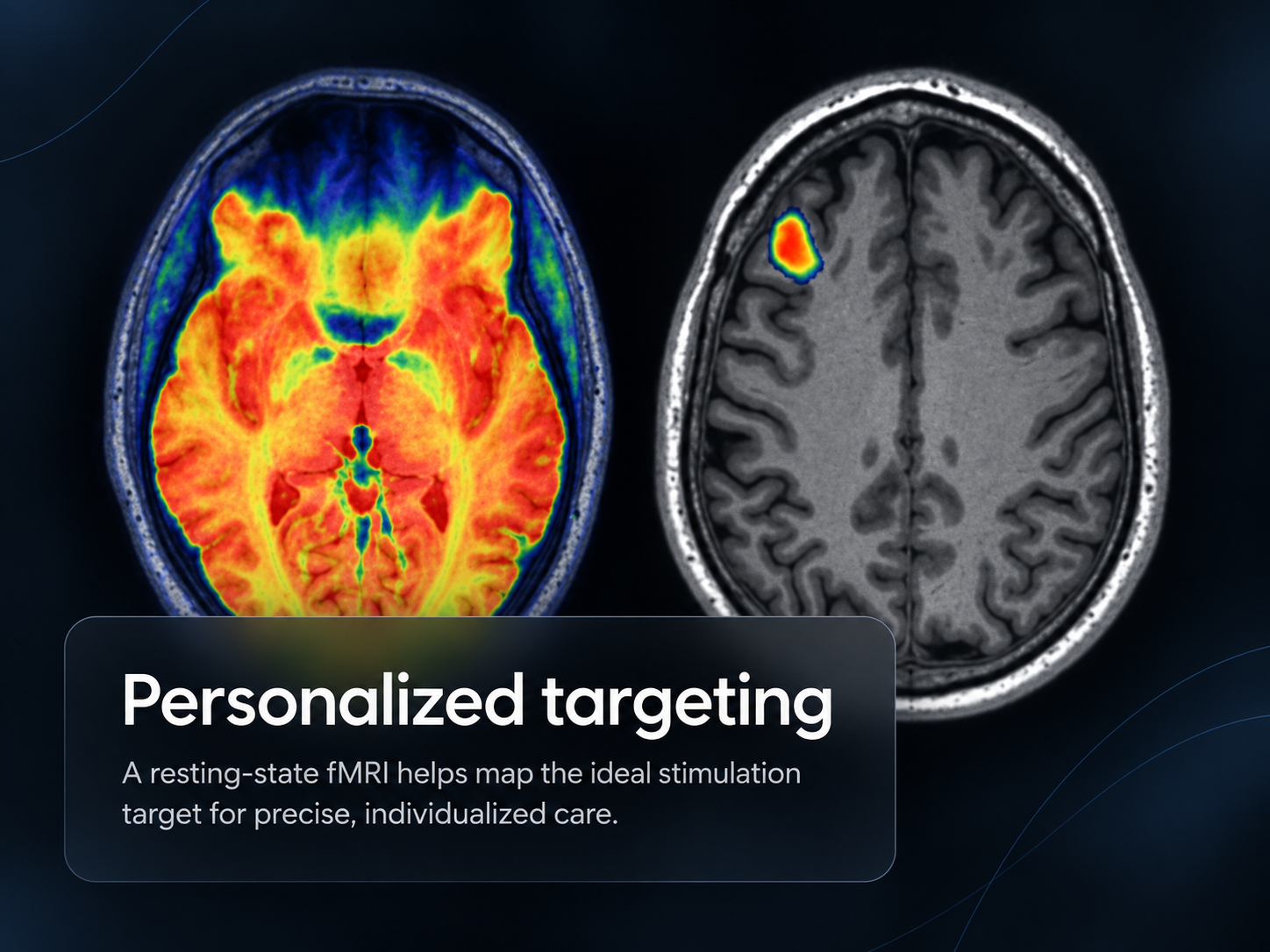
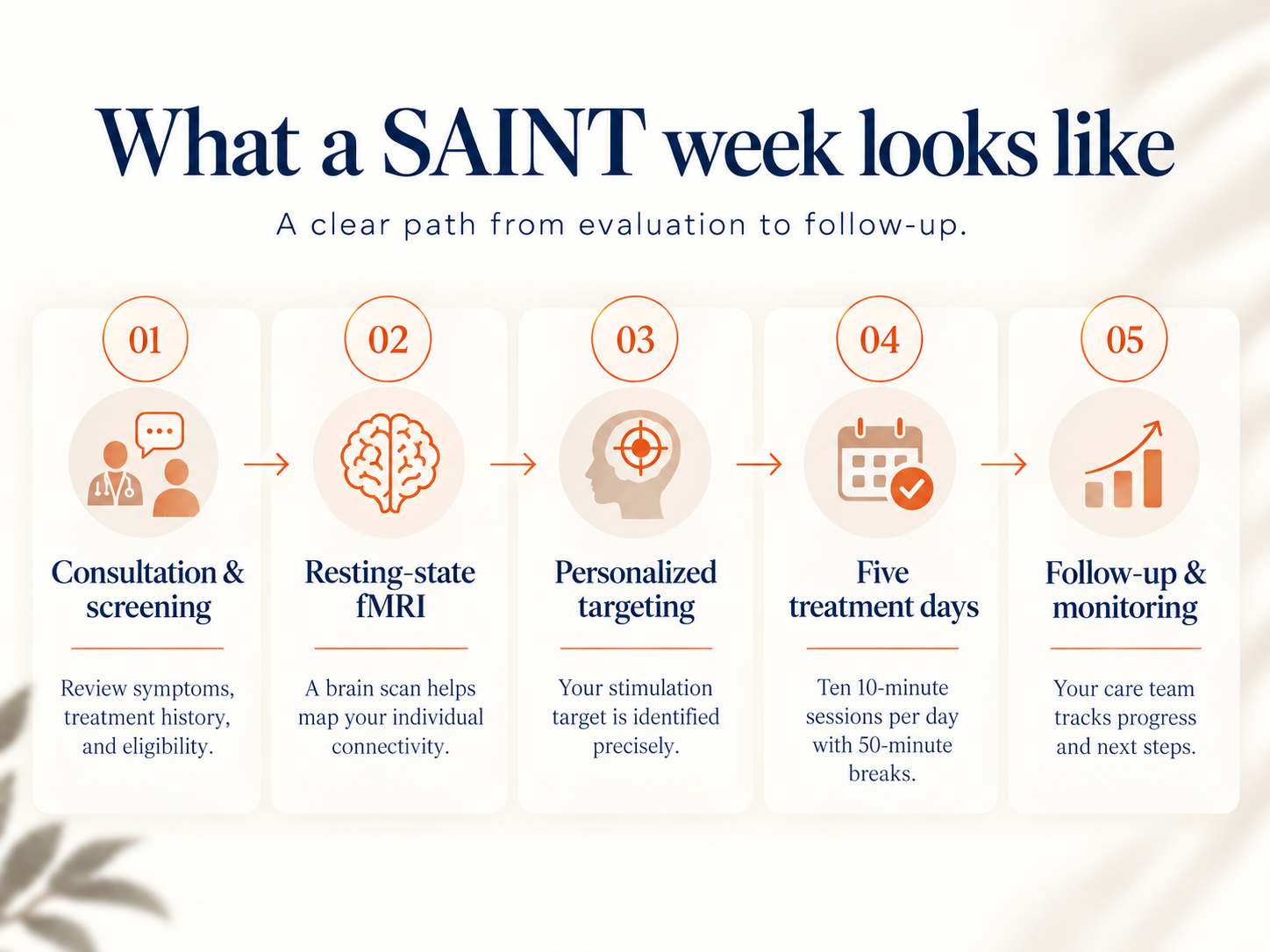
Personalized fMRI Targeting
Maps individual connectivity to identify the exact stimulation target.
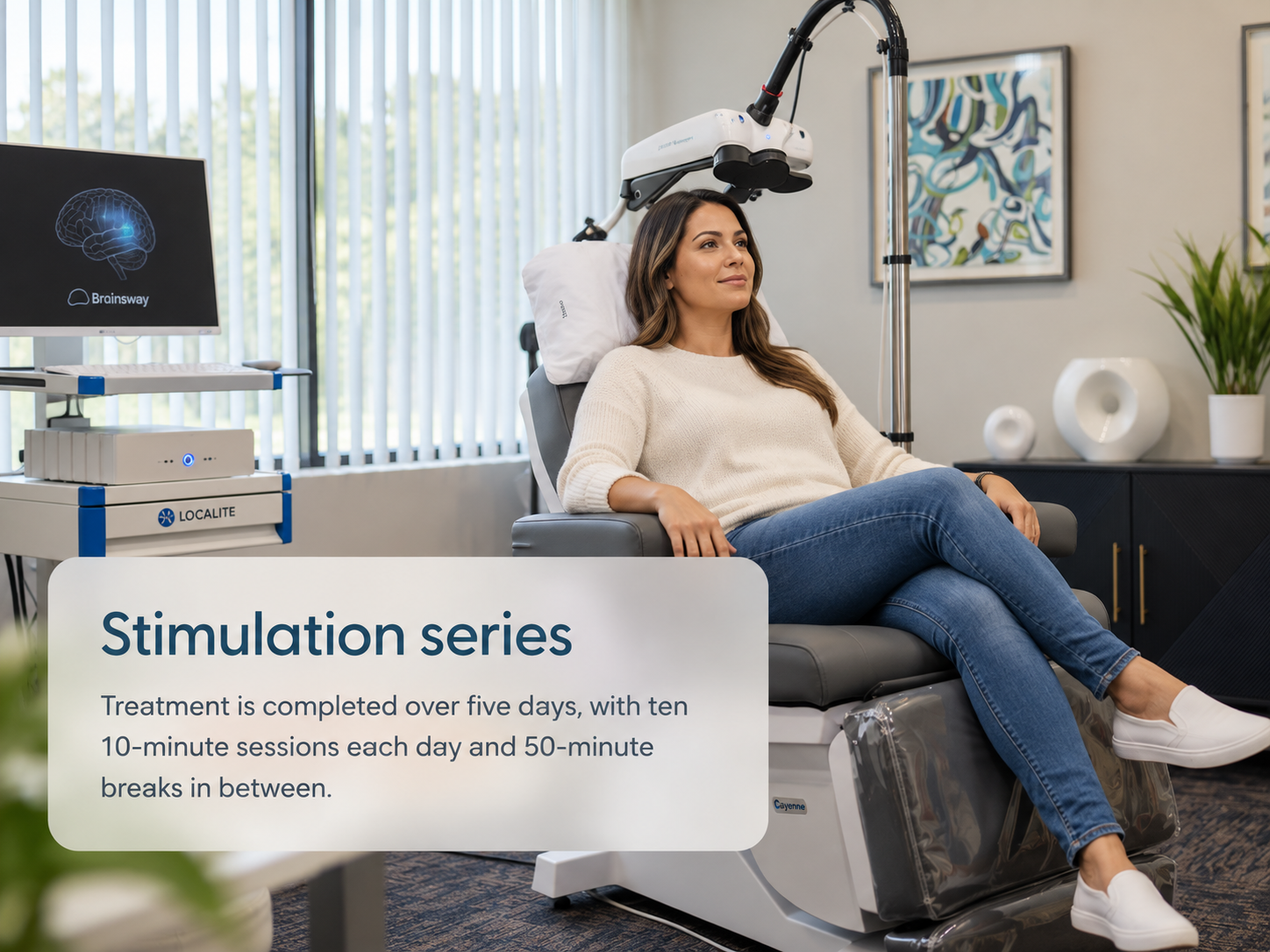
Five-Day Stimulation Series
Ten 10-minute sessions daily with 50-minute breaks; awake, alert, no downtime.
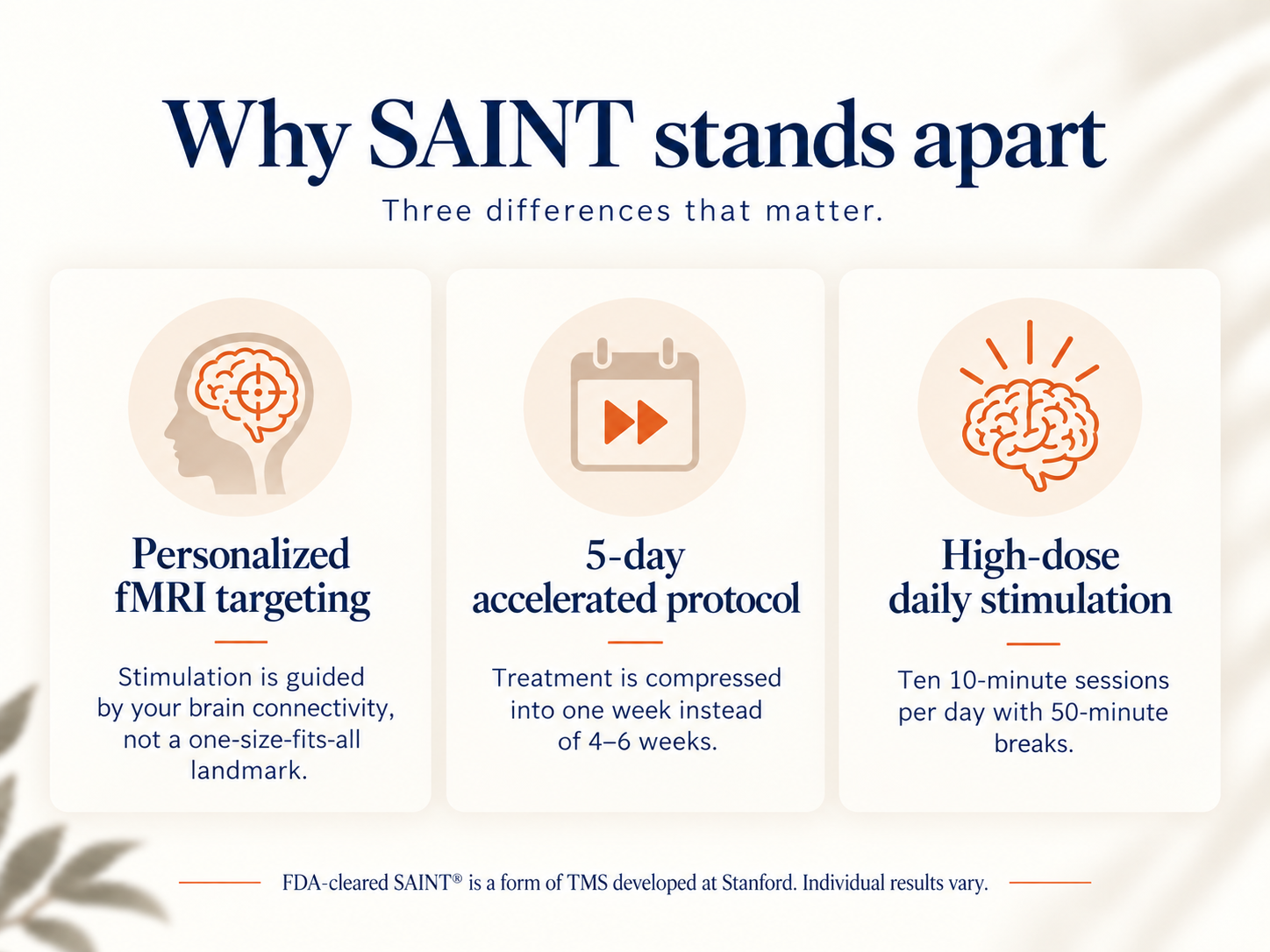
Two things separate SAINT from every other option on the table:
1. Precision Targeting with fMRI
Before treatment begins, you get a resting-state functional MRI (fMRI), roughly 45 minutes, that maps how your individual brain networks are wired. A targeting algorithm reads that scan and identifies the exact spot where stimulation will most effectively reach the mood-regulation network. Neuronavigation then guides the coil to that location for every single session. No other FDA-cleared depression treatment uses your own brain imaging to plan your care.
2. Dose and Speed (5 Days vs. 6–9 Weeks)
Instead of one session a day for weeks, SAINT delivers ten 10-minute sessions per day, with 50-minute breaks in between, over five consecutive days. That's five clinic visits instead of 30 to 36. The total stimulation delivered is substantially greater than a standard TMS course, compressed into a single week. Most patients notice a shift in mood within the first couple of days.
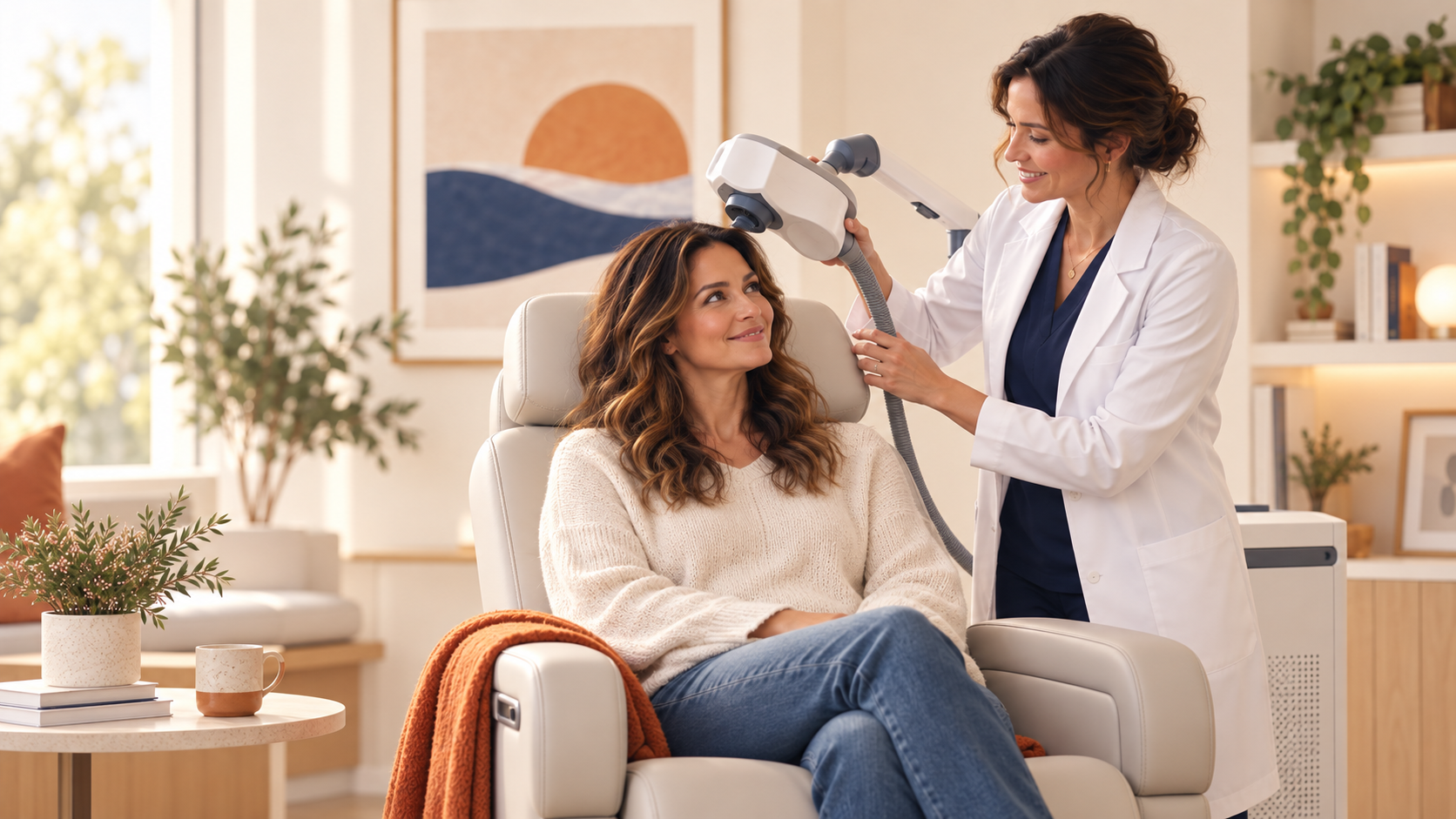
Gentle, Alert, and Fully Supported
Sessions last only 10 minutes each. You remain awake and comfortable in our private treatment chairs, supported every step by your dedicated clinical team.
3. Dedicated Private Suites & Outpatient Comfort
During your 50-minute breaks between sessions, you have access to our dedicated SAINT Lounge Wing. Each private furnished suite is equipped with high-speed Wi-Fi, work desks, plush seating, 4K streaming TV, Keurig coffee bar, and refreshments. Our on-site care team checks in throughout the day to ensure you are comfortable, relaxed, and having your lunch at ease. Family members or loved ones accompanying you are welcome to relax in the suite with you so you always feel right at home.
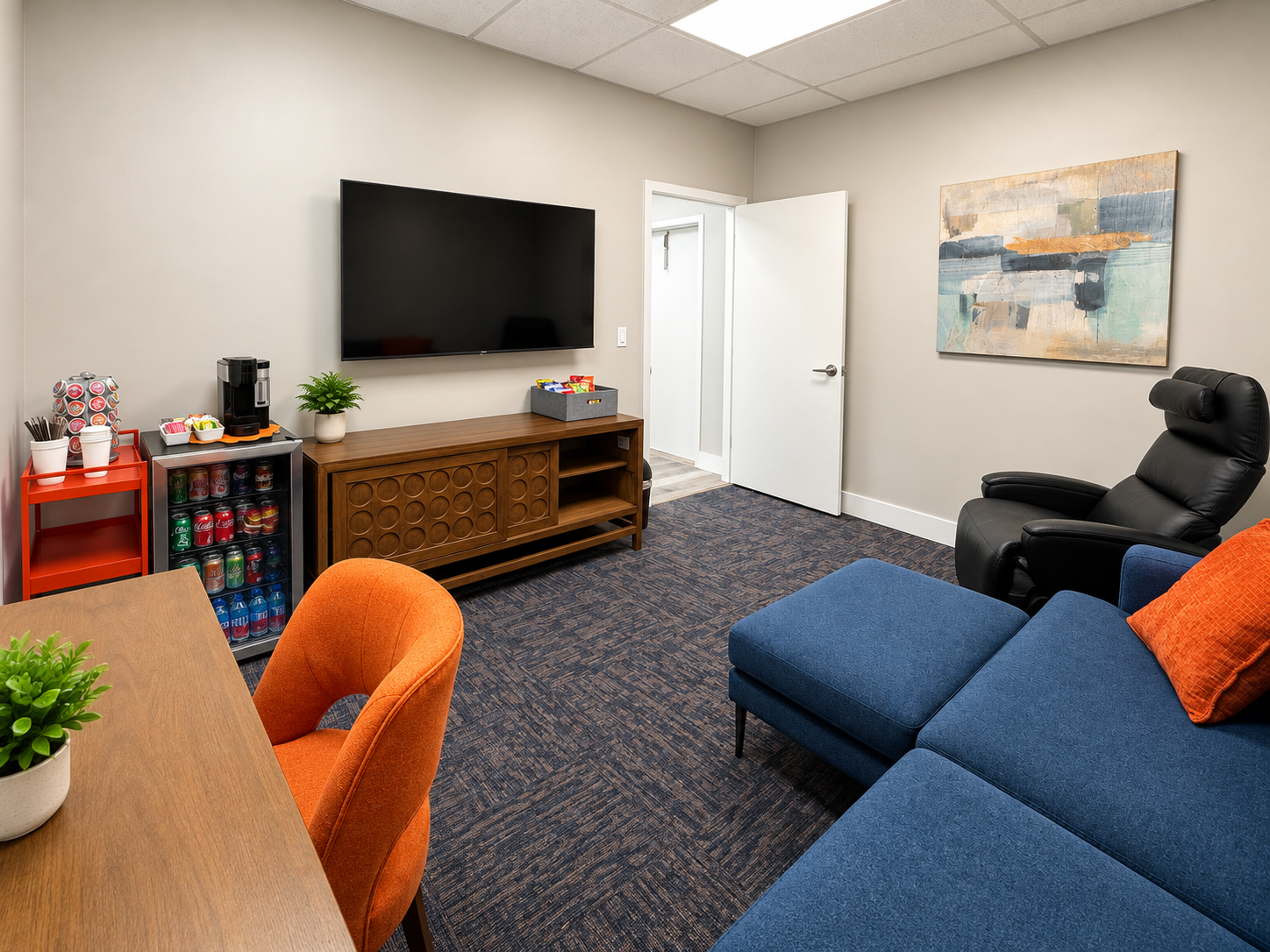
Private SAINT® Lounge Suite Experience
Designed for comfort and privacy—relax, work, enjoy lunch, or spend time with family between your daily 10-minute sessions.
Like standard TMS, there's no anesthesia and nothing enters your bloodstream. Across more than 400 patients treated in clinical trials, 85 percent experienced symptom relief, with no serious adverse events. The most common side effects were mild headache, fatigue, and temporary scalp discomfort. SAINT isn't appropriate for people with non-removable metal in or near the head or an implanted device, and you'll be screened for these at your consultation.
What this means for you
If you've tried one medication and it's working reasonably well, you probably don't need anything on this table. Stay the course.
But if you've tried two or more and you're still meeting criteria for depression, the table tells a clear story. Continuing down the medication path offers a low chance of remission and a long wait. Esketamine offers a modest chance and an open-ended commitment. Standard TMS and ECT offer better odds but demand weeks of your time, and in ECT's case, anesthesia and memory risk.
SAINT offers the highest remission rate of any option, in the shortest time, without anesthesia, without medication, and without a six-week schedule. That's not a marketing claim. It's what the published data shows.
You don't have to stop your current medications to pursue it. Most patients continue their existing regimen through treatment.
What to do next
Reading a comparison table is one thing. Knowing where you fall on it is another. That's what a consultation is for.
Neuro Wellness TMS Centers of America is a Verified SAINT® Provider offering private outpatient care with a dedicated care team and weekend availability. Your first appointment is an evaluation, not a commitment. We'll review your history, your medication trials, and your current symptoms, and tell you honestly which option on this table is right for you. If it's SAINT, we'll walk you through the scan, the schedule, and what to expect during your treatment week. Insurance coverage varies by plan; our team can help you understand your options, including prior authorization and self-pay.
Data shown are drawn from published studies in treatment-resistant depression and related patient populations. Study designs and populations vary. Individual results may vary. Consultation required. If you are in crisis or thinking about harming yourself, please call or text 988 (Suicide and Crisis Lifeline) or go to your nearest emergency room. This article is for educational purposes and is not a substitute for individual medical advice.
Frequently Asked Questions
What is the difference between remission and response?
Why is SAINT's remission rate higher than standard TMS?
Do I have to stop my current depression medications?
Does insurance cover SAINT therapy?
Can I print or download this comparison chart?
Explore Related Resources
What Is SAINT® TMS Therapy?
Detailed overview of the 5-day accelerated, fMRI-guided protocol.
You've Tried Everything. Why Is the Depression Still Here?
What treatment-resistant depression means and why medications fail for some.
Depressed and Anxious at the Same Time? You're Not Confused.
Why depression and anxiety overlap and how shared brain circuits respond.
Check My Insurance Options
Fast, confidential review of your mental health coverage.
Ready to talk to someone?
The hardest part is usually the first phone call. Everything after that is a series of small, defined steps.
You Don't Have to Figure This Out Alone
Request a Free Consultation